Kelly Barron

Mindfulness in schools, at work & everywhere

  • About
  • Mindfulness
    • In Schools
    • At Work
    • Mindfulness Coaching
  • Testimonials
  • Writing
    • Newsletter
    • Articles
  • Classes
    • Unified Mindfulness
    • One-On-One Coaching
  • Events
  • Contact

Reframing Social Isolation as Seclusion

April 29, 2020 By kelbarron

For many city dwellers, the physical world has shrunk to the single-digit walls of their apartments. In dense suburbs, postage-stamp-sized backyards have become parks. Getting out for brief walks along the familiar streets of home has become a new form of commuting.

Many among us are suffering now—gravely ill, steeped in grief, or worried sick about how we’ll pay the rent. We’re hunkering down with social distancing, at-home sheltering, and lockdowns as new normals. Tedium is setting in.

Yet, as the boundaries of our physical world contract, the limits of our mental, emotional, and spiritual worlds have the potential to expand.

Meditation teacher Shinzen Young compassionately suggested to students on an online retreat recently that they could reframe the pandemic predicament of social isolation as a time of seclusion during which their mindfulness practices could deepen. Provided our basic needs get met, such a subtle shift in perspective has the power to lighten our load psychologically.  

For centuries, human beings have used seclusion to birth creativity, for physical, psychological, and spiritual renewal and as a means of understanding fundamental truths about the world.

Great inventors, philosophers, artists, writers, and the like, from Albert Einstein to Harper Lee to Georgia O’Keeffe to James Baldwin to Bill Gates and countless others valued time alone. Often, they contributed their gifts to the world after phases of reflection and solitude. There’s a reason silent retreats are a mainstay of mindfulness practice.

Like a good broth, sometimes we need to simmer our lives on the stove to uncover the richness within us.

Yesterday, from my open kitchen window, I heard the painful sounds of an inexperienced violinist in my neighborhood struggling to discover the music within her. I thought about the passion projects, the inventions, the new business ideas coming to life during our worldwide hibernation. It also takes relentless creativity to keep kids entertained and engaged all day and to run a household amid shortages, stoppages, and uncertainty.

Thankfully, not all creativity is serious. The other day I got the giggles watching comedian Will Ferrell methodically wash his hands for 20 seconds while singing George Michael’s “Careless Whisper.” My husband is playfully growing his facial hair into a ridiculously retro mustache. So far so good on the home front, but I can do without the 1970s slang he’s tossing around. “Can you dig it?”

Seclusion also makes room for renewal and insight. My neighbor’s frequent, bi-coastal air travel has halted, allowing him to recoup his energy, and spend more time with the family. A back injury his older son incurred during rowing team practice is mending. His younger son finds Zoom learning more enriching and less distracting than being in a loud classroom.

Perhaps more starkly, when we’re secluded, there are fewer excuses to avoid the inner work that our souls naggingly request. A lot rises to the surface in difficult times—maladaptive ways of coping and harmful behaviors we only dimly see in the rush of our busy routines. If we’re willing and able, we can lovingly turn toward it all and gently begin the work of healing. 

Whenever you feel the fizzy energy of anxiety bubble up, stop and, like a mother attending to a toddler, give it your attention.

  • Take a breath.
  • Put your hand over your heart and soften your belly, giving the anxiety more space to move through you.
  • If it’s all too much, turn your attention away.
  • Feel your feet on the ground, listen to the hum of the heater or turn the on the TV, and watch a Hallmark movie. Either way, you’ll have mindfulness as your companion.

The other morning a friend shared that when he was a little boy, he loved to watch his grandfather prune trees, and his memory of it has become a helpful metaphor during the COVID-19 crisis.

He explained that after the pruning, once the trees were down to their bare essence, they entered a period of botanical seclusion and apparent dormancy. But in time, the trees stood tall again—more lush and beautiful in the morning light.

We are in a time of tremendous pruning and seclusion, said my friend.

Let’s hope and trust that when this period ends, we, too, will emerge from our global seclusion more vibrant and beautiful than before.

This post originally appeared on Mindful.org https://www.mindful.org/
Filed Under: Uncategorized

The Wonders of Walking

April 26, 2020 By kelbarron

Forget baseball. It’s official now. America’s favorite pastime is walking.

With COVID-19 lockdowns in full force, walking has become a liberator from the confines of home turned office turned school. Going for a walk is now a standard diversion from a world that’s both wildly uncertain and tediously routine. A stroll around the block isn’t as exciting as a trip to Kuala Lumpur. But there are discoveries on every outing.

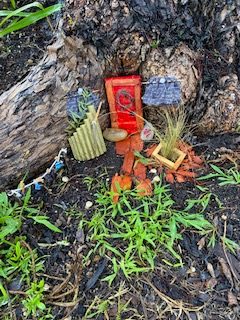
While on a walk recently, a friend of mine spied a series of “fairy gardens” that children in his neighborhood made at the base of trees. Tiny doors set against the tree trunks presumably opened into a magical land. (See pictures below.) My friend took this as a hopeful sign. Maybe the children know that somewhere out there is a better world, he mused.

In my neighborhood, it’s become prime-time entertainment to look out my kitchen window and see pedestrians boldly walking down the middle of empty streets. A hot pink mask counts for fashion on the catwalk of LA sidewalks now. I can’t tell if the dogs I see trotting alongside their owners on their multiple daily jaunts are gleeful or exhausted.

Long before COVID-19, we knew walking was good for us and that sitting was the new smoking. Fitbits and iWatches prodded us to get off the couch. But it took a pandemic to motivate us. It’s one habit that I hope stays with us whenever our world returns to normal.

Standing upright and propelling ourselves forward on two legs is uniquely human. Walking is so beneficial to us in so many ways that if it were a pill, we’d pop it like an M&M.

Walking is one of the most studied forms of exercise, and research shows that it can lower body mass, cholesterol, and blood pressure. It improves memory and cognitive function. Studies also show that walking can boost our moods and reduce depression. It even spurs creativity. Have you ever wondered why your best ideas strike you while strolling?

Researchers at Stanford asked people to come up with alternative uses for everyday objects and found that people who walked before given the task came up with twice as many ideas as those who stayed put.

A walking brain is a more active brain and is more capable of ideation and creation, according to Shane O’Mara, a Trinity College professor and author of the book “In Praise of Walking: A New Science of Exploration.” She recommends that before working on any thorny problem, you write down a few questions about your dilemma or project and then take a hike. Often, the issue solves itself before you return home.  

Walking is the low-hanging fruit of physical activity. And if you’re getting less than 5,000 steps a day, you’re considered “clinically sedentary.” Physical therapist and mobility guru Kelly Starrett says that our ancestors walked while carrying heavy things. He sometimes schleps a 50-pound sandbag when he walks just to up the ante. 

But, of course, it’s enough to put one foot in front of the other. You can do so mindfully by paying attention to the swing of your legs and the step of your feet. Bringing awareness to the body and using walking as a meditation is a sure-fire way to quiet a mind whirling with worry.

What’s more, you’ll never know what you’ll discover once you’re out the door. I like to walk at dusk when the street lamps begin to illuminate the peace that descends over my neighborhood at night. If I can get a walk during the day, I’ll do that, too.

The other morning, I felt a bit deflated, realizing that we’re in for a long COVID-19 haul. To boost my spirits, I went on a walk and came across a poem – yes, a poem – that was heaven-sent.

Typed out on a sign in a neighbor’s yard were the lines below from poet Edna St. Vincent Millay. Maybe you’ll discover something just as inspiring on your next walk.

 “From the apprehensive present, from a future packed
With unknown dangers, monstrous, terrible and new-
Let us turn for comfort to this simple fact:
We have been in trouble before… and we came through.”

–Edna St. Vincent Millay  
 

Filed Under: Uncategorized

Thanks to the Unsung Heroes of COVID-19

April 26, 2020 By kelbarron

Before the COVID-19 pandemic, how many of you appreciated the work of airline reservationists, garbage haulers, grocery store cashiers, delivery people, janitors and housekeepers, waiters, and waitresses, cooks, and bakers, etc.

Like rambling Oscar winner accepting her award, I know I’m leaving so many others out.

But the cogs in the wheels of society are rarely valued until the machinery is exposed. And right, now, everything is exposed.

My daughter turned 17 yesterday. Her birthday was a quiet, at-home-sheltering affair with a Zoom session with friends and more time with family. A very bright spot: a birthday cake from a local baker, who I profusely thanked for her confectionary ray of sunshine. Who knew bakeries were essential and still open during a pandemic?  

The truth is so many people are essential to our civic functioning who go unnoticed or are only casually recognized.

We herald our doctors, but often forget our nurses, hospital administrators, or janitors, who are working extra hard now to keep things sanitized.

The seamless way packages arrive at our doorsteps shields us from the role package pickers, boxers, drivers (again, I can only guess how many I’m leaving out.) play in getting goods to us often within a day of ordering.

We love (for Trader Joes that’s not too strong of a word) our grocery stores, but typically don’t think about people inside them keeping shelves stocked.

A recent story in the Wall Street Journal mentioned how the pandemic might close our borders to new immigrants in the future, but noted that it’s immigrants who are doing much of the work on the front lines of COVID-19. They’re in the hospitals, in the grocery stores, and out mowing our lawns.

Many of them are afraid of getting sick, but they’re still doing the work because they need a paycheck or simply because they feel it’s the right thing to do.

All of it reminds me of the reflection I use before I teach students how to eat a grape mindfully. Before we begin, I ask students to picture a vineyard and imagine the causes and conditions that came together to put a single grape in their hands.

Sun, rain, and soil nurture the vines. Farmers tend to the grapes. Pickers harvest them, and factory workers package them. Drivers bring the grapes to stores traveling along roads others built. And grocery store employees set the bunches of grapes on the shelves so we can buy them.

Those are just the top notes in a series of mind-boggling connections involving a single grape. Every day, countless relationships allow our lives to hum along often without a glitch.

Once in awhile, it’s worth picking out an object – your toothbrush, your shoe, or your computer – and think about the invisible hands that brought it to you. It’s good to remember how connected we are and how many unrecognized people support us.

New Yorkers, like Italians, are leaning out their windows and banging their pots and pans to salute doctors, paramedics, and, yes, nurses as they battle a rising tide of COVID-19 cases.

Let’s do some “Hip Hip Hoorays” for everyone else as well. Feel free to thank the UPS delivery person, the grocery store cashier, and the smiling baker, too. 

At the beginning of COVID-19, I called Alaska Airlines to cancel a plane ticket. It took me a long time to get through. When I finally got to a representative, it occurred to me to ask her how she was doing. Surprised by my question, she paused. Then, she gave me an honest answer. She told me that the night before – after a long day of handling calls from frustrated and angry customers – she broke down and cried.

Everyone and, particularly those we don’t usually recognize, is trying to do their best right now. And that alone deserves our thanks.
  

On My Mind

Sometimes just a few well-written words can lift us from despair. The other day, I sent these lines from poet Linda Hogan to a friend, who told me that after reading them she could feel her shoulders drop. May they bring you ease as well:

Suddenly all of my ancestors are behind me.
Be still.
They say.
You are the result of the love of thousands.

Filed Under: Uncategorized

The Covid-19 Time Warp

April 26, 2020 By kelbarron

The other morning I looked out my dining room window to see a now-familiar sight – kids and teenagers riding their bikes along the empty streets of my usually well-trafficked Los Angeles neighborhood.
 
As a kid, my bike was a source of freedom and discovery.
 
When I was 15 years old, I rode my 10-speed 46 miles round trip from my suburban home in Annandale, Virginia, to our nation’s capital. My mother was horrified when I told her where I’d been. But I still remember the thrill of coasting down the roads that wove through Arlington National Cemetery before heading across the Arlington Memorial Bridge into Washington, D.C.
 
Until recently, the kids and teens I know didn’t ride their bikes much.
 
But amid the COVID-19 pandemic, we’ve regressed socially. It’s as if we’ve drifted back in time to rediscover activities and ways of being with each other that were the norm before technology so enthralled us.

With at-home sheltering and lockdowns narrowing our entertainment options, long walks are a major attraction. Neighbors more accustomed to keeping to themselves, venture out onto their front lawns to share the news of the day over fences and hedges. Sometimes, at cocktail hour, they remotely raise a glass of wine in a sign of social-distancing solidarity.

Jigsaw puzzle sales are skyrocketing. Bread making is popular. And books have become treasured friends. Some of us are even living off the land.
 
I’m ashamed to admit that I’ve often been too busy or lazy to make use of the vegetables my husband grew in a small planter outside our kitchen. Home-grown kale went to waste. Now, I’m harvesting collard greens and chard like an urban farmer.
 
I don’t want to diminish anyone’s suffering because I’m acutely aware that some of us are suffering more than others as a result of the pandemic. (See below) But, I imagine, in some ways, the forced return to a 1950s-style simplicity is soothing to our otherwise jangled nervous systems.
 
As a mindfulness teacher, I am always promoting the value of slowing down and taking time to reconnect to yourself and others. It’s baked into mindfulness and meditation, and it’s one of the reasons why these practices are first-responders in times of difficulty. (Not surprisingly, sales of meditation apps are up during the pandemic.)
 
It’s challenging to feel at ease with so much uncertainty. But it’s worth bringing some mindfulness to notice what unhurried pursuits feel particularly good to you now.
 
Does strumming the guitar you buried in the closet, but have recently reclaimed bring a smile to your face? Are you enjoying the connection you have with your kids while playing a game of Go Fish? Maybe reading Joseph Conrad’s Heart of Darkness for the third time, as my bookworm friend recently did, delivers you to a quiet place inside you.
 
If you’re still moving fast, while the rest of the world orbits at a slower pace, is it possible to give yourself a break – even if it lasts for just three full, purposeful breaths?
 
Hopefully, all of us will be back in our fast-paced world again soon. Perhaps some of the things we discovered when we had to decelerate our lives will stay with us. If not by design, maybe by intention. 

On My Mind

COVID-19 affects everyone. But it affects everyone differently. Joe Pinsker’s excellent article in the Atlantic magazine on how some segments of the population are faring better amidst the pandemic than others is a thought-provoking read. It invites all of us to have more compassion for those for whom the pandemic is particularly brutal. https://www.theatlantic.com/family/archive/2020/04/two-pandemics-us-coronavirus-inequality/609622/ 

Highly Entertaining

And now for Some Good News. That’s the name of actor John Krasinski’s YouTube channel highlighting what’s kind, funny, and uplifting about the world despite COVID-19. If you’re feeling remotely downcast, and who among us hasn’t recently, I highly recommend it. Also, my friend’s son recently made a cameo on the show as his acapella choir group Squad Harmonix recorded a delightful opening promo that Kransinski picked up in this episode. Enjoy! https://www.youtube.com/watch?v=Eg08rJGKjtA&t=39s

Filed Under: Uncategorized

Mindful Leadership During COVID-19

April 8, 2020 By kelbarron

In the weeks since the coronavirus pandemic has unfolded, leadership on the world stage has been in the spotlight. We’ve had both good and bad examples of it.
 
Good leadership can take many forms. But we know it when we see it, and we can feel it.
 
Good leadership makes us feel as though someone has our back and that no matter what we face, we have a defined, if not always clear path, through it. Good leaders aren’t avoidant, and they’re consistent and as reliable as an oak desk. Good leaders also aren’t always severe. Sometimes they’re soft with plenty of kindness and empathy for those who endure hardship during a crisis.
 
Of course, that’s just my two cents. Shelves are full of books on leadership, and Business schools offer plenty of management classes.
 
Often, though, the qualities we admire in effective leaders are the qualities that mindfulness fosters. The term “mindful leadership” gets bandied about a lot these days for good reason. The self-awareness that mindfulness and meditation develop gives leaders a wide range of psychological tools to draw upon during a crisis – everything from open-mindedness to cognitive flexibility to kindness. 

On my Mind

When things are bad, why not focus on the good or even the inspiring. In terms of leadership, there have been some standouts in the inspirational category.

Here are a few of my picks. Also, watch the video below of the steadfast, but empathetic speech from German Chancellor Angela Merkel informing the German public of the necessary sacrifices they’ll need to make to contain COVID-19.

Merkel, by the way, has been leading from home. She’s in quarantine after coming in contact with a doctor who tested positive for the coronavirus. Thus far, she has tested negative for the virus, according to news reports. 

1) With only a few cases of COVID-19 reported in early March, Ohio Governor Mike DeWine moved swiftly to shut down large-scale events, schools, and sporting events. Some criticized him for doing so. But now he looks like a savant. 

2) New York Governor Andrew Cuomo hasn’t sugar-coated his speeches to New Yorkers about the COVID-19 hardships. His tough talk has motivated others to rise to the occasion, including legions of doctors, nurses, cops and National Guard forces who are now at the epicenter of the pandemic in the U.S. Here’s a link to the transcript of his rousing speech to National Guard troops. https://abcnews.go.com/US/read-gov-cuomos-moving-speech-defeating-coronavirus/story?id=69839370

3) Los Angeles Mayor Eric Garcetti also has made unpopular but prudent choices such as shutting down parks and beaches after Los Angelenos flocked to them flouting social distancing requirements. 


https://www.youtube.com/watch?v=WLxrxyk_wYo


Filed Under: Uncategorized

  • « Previous Page
  • 1
  • …
  • 7
  • 8
  • 9
  • 10
  • 11
  • 12
  • Next Page »

Copyright © 2026 Kelly Barron· Site design: Ilsa Brink